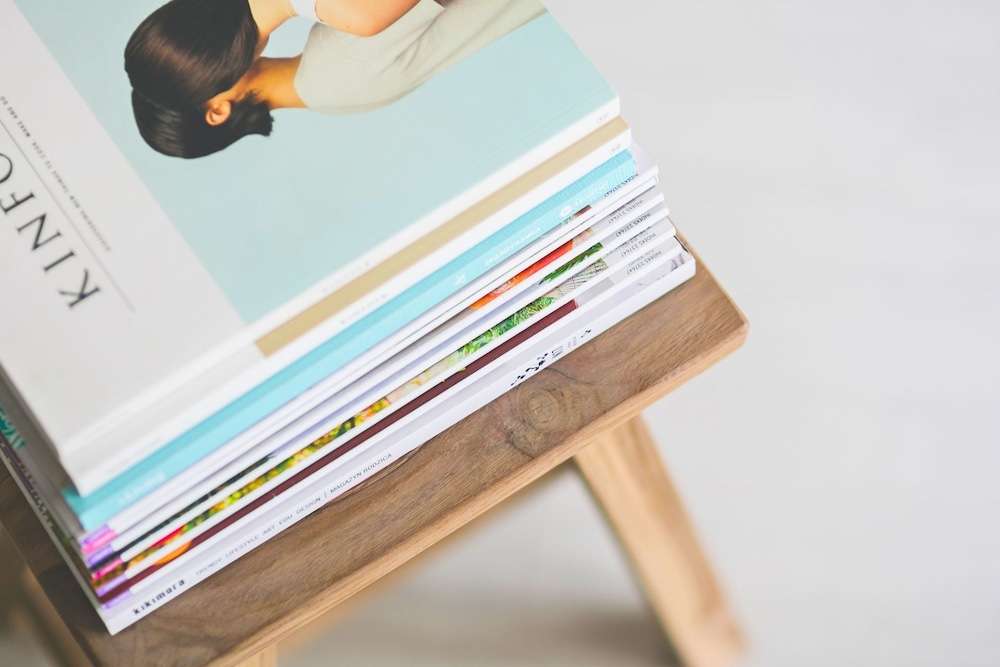
A magazine is not a brochure with better paper.
It sounds obvious, but it is one of the most important distinctions a brand can make when thinking about print.
Because a lot of organizations say they want a magazine when what they really mean is: we need somewhere to put everything.
The brand story.
The founder story.
The service list.
The product details.
The partner logos.
The testimonials.
The seasonal campaign.
The QR code.
The big message.
The smaller messages.
The message someone in the meeting really wanted included.
That is how a magazine becomes a brochure in disguise.
And people can tell.
They may not use those exact words, but they know the difference between something made for them and something made at them.
A brochure often says, “Here is what we offer.”
A magazine says, “Here is the world we understand.”
That difference changes everything.
Print gets into trouble when it is treated as a container.
A place to hold information. A place to explain everything. A place to make sure every department, product, service, stakeholder, and sales point gets represented.
The result may be accurate. It may even be beautiful.
But it often lacks a reason to be read.
That is the problem.
A printed piece can be well designed and still feel like work. It can be expensive to produce and still be forgettable. It can be filled with useful information and still fail to create any meaningful connection.
Because people do not keep print because it contains information.
They keep it because it gives them something: inspiration, usefulness, context, beauty, belonging, desire, confidence, or a better way to imagine what comes next.
That is where magazines, custom publications, and branded editorial products become powerful.
They are not just containers for brand messages.
They are experiences.
This is not an argument against brochures.
A good brochure has a job. Sometimes you need a concise, clear, practical piece that explains a product, service, program, place, or offer. There is absolutely a role for that.
But a brochure and a magazine should not be expected to do the same thing.
A brochure usually informs.
A magazine invites.
A brochure is often designed around what the brand wants to say.
A magazine is designed around what the reader may want to spend time with.
A brochure tends to compress.
A magazine creates space.
A brochure is often a sales support tool.
A magazine can become a brand platform.
A brochure explains the offer.
A magazine builds the world around the offer.
That last point matters most.
For many brands, the decision someone is making is not purely transactional. They are not just choosing a hotel, a destination, a neighbourhood, a wellness experience, a cultural event, a retail brand, or a service provider based on a list of features.
They are responding to context.
How does this feel?
Is this for someone like me?
Do I trust this brand?
Can I picture myself there?
Does this align with what I value?
Is there a deeper reason to care?
A magazine gives you room to answer those questions without sounding like you are answering them.
The biggest shift from brochure to magazine is not format. It is mindset.
A magazine starts with the reader.
Not the organization.
Not the sales sheet.
Not the internal messaging hierarchy.
Not the list of things that “have to be included.”
The reader.
What are they curious about?
What do they need to understand?
What would make them slow down?
What would feel useful, inspiring, or worth keeping?
What story can we tell that gives this brand more meaning?
That is editorial thinking.
It does not mean the brand disappears. It means the brand shows up with more generosity.
Instead of asking only, “What do we need to promote?” a strong custom publication asks, “What can we create that our audience would genuinely value?”
That might be a travel magazine that makes a region feel more layered and worth exploring.
A wellness publication that gives readers a more thoughtful way to understand care, rest, movement, or transformation.
A real estate magazine that helps people imagine a lifestyle, not just a floor plan.
A retail publication that turns products into culture, context, and taste.
A B2B magazine that makes a complex category easier to understand through insight, interviews, examples, and stories.
The brand is still there. In fact, it may be more powerful because it is no longer shouting from every page.
It is curating. Guiding. Framing. Showing what it understands.
A strong magazine needs more than content.
It needs a point of view.
That point of view does not have to be loud. It does not have to be controversial. It does not have to be clever for the sake of being clever.
But it does need to be clear.
What does this publication believe?
What does it notice that others miss?
What kind of stories belong here?
What kind of reader is it serving?
What does it help people see differently?
Without a point of view, a magazine becomes a collection of nice pages.
With a point of view, it becomes a world.
This is where many branded publications fall short. They may look polished, but they do not have an editorial centre. The stories feel interchangeable. The structure feels assembled. The voice feels generic. The reader is left with information, but not much impression.
A point of view gives the publication shape.
It helps decide what belongs and what does not. It creates consistency across writing, design, photography, story selection, pacing, and distribution. It gives the reader a reason to trust the experience.
And for the brand, it creates something far more valuable than a one-off piece of collateral.
It creates a recognizable editorial platform.
This may be the hardest part for organizations to accept.
A great brand magazine is rarely about the brand in the most obvious sense.
It is about the world around the brand.
The people it serves.
The places it belongs.
The values it reflects.
The questions its audience is asking.
The experiences it makes possible.
The culture it participates in.
The future it is helping shape.
A tourism organization may publish stories about makers, trails, restaurants, rituals, hidden corners, seasonal rhythms, and the emotional pull of a place.
A hospitality brand may explore local culture, design, food, rest, nature, and the art of arriving well.
A wellness brand may look at the many ways people define feeling better, beyond treatments or programs.
A retail brand may build a publication around style, craft, travel, community, or the rituals of everyday life.
A business-facing brand may use a magazine to explore industry shifts, customer challenges, leadership ideas, and practical intelligence.
In each case, the brand is not absent.
It is present through the lens.
That is the difference between promotion and positioning.
A magazine earns its place when it gives the reader a reason to return to it.
That does not happen by accident.
A custom publication worth keeping usually has a few essential ingredients.
A clear reader
You need to know who the publication is for. Not in vague demographic terms only, but in terms of mindset.
What are they looking for?
What do they care about?
What stage of awareness are they in?
What would feel valuable to them?
A magazine for a first-time visitor is different from one for an industry partner. A publication for affluent travellers is different from one for local residents. A magazine for prospective donors is different from one for customers who already know the brand.
The reader shapes everything.
A strong editorial concept
The magazine needs a reason to exist beyond “we wanted to make one.”
The concept might be seasonal, thematic, regional, campaign-driven, community-led, founder-led, or built around a particular audience need.
But it should be sharp enough to guide story selection.
If the editorial idea is too broad, the publication becomes a catch-all. If it is too narrow, it may run out of energy. The best concepts create both focus and room.
Useful, interesting stories
A magazine does not need to be purely service-driven, but it should reward attention.
That might mean practical guidance, strong interviews, beautiful essays, destination features, behind-the-scenes stories, trend pieces, profiles, maps, itineraries, visual storytelling, or expert insight.
The format matters less than the value.
A reader should feel like they got something from the time they spent with it.
Thoughtful pacing
A magazine is an experience in sequence.
It has openings, pauses, features, shorter pieces, visual breaks, recurring sections, moments of depth, and moments of ease.
This is one of the reasons editorial structure matters so much. A magazine should not feel like a stack of unrelated articles. It should feel considered from front to back.
Design that serves the story
Beautiful design matters, but the job of design is not simply to make the magazine look good.
It helps create hierarchy, rhythm, mood, clarity, and desire. It affects how people move through the publication and how they perceive the brand behind it.
Design can make a publication feel premium, warm, playful, luxurious, useful, intimate, bold, or calm. It can also make a potentially strong idea feel generic if the visual system does not support the story.
Intentional distribution
Even the strongest magazine cannot work if no one knows where it belongs.
Distribution should be part of the strategy from the beginning.
Will it live in hotel rooms, shops, welcome packages, events, visitor centres, trade shows, sales meetings, direct mail, partner locations, subscription boxes, retail counters, waiting rooms, galleries, offices, or community spaces?
The physical context matters.
A printed publication is not just read. It is encountered.
A connected next step
A magazine can be slow, beautiful, and editorial, but it should still know where it is leading.
That might be a website visit, inquiry, booking, event registration, store visit, donation, sales conversation, social follow, newsletter sign-up, video view, or deeper content experience.
The next step should feel natural, not forced.
The magazine creates the relationship. The ecosystem continues it.
A custom magazine or branded publication can be a strong fit when a brand has more to say than a simple ad, brochure, or landing page can hold.
It may be especially useful when the brand needs to:
Build trust over time
Tell a more layered story
Create a premium physical experience
Support a campaign, launch, event, or seasonal push
Bring partners, advertisers, or community voices together
Educate an audience without sounding instructional
Make a destination, product, service, or idea feel more desirable
Support sales with something more substantial than a deck
Create content that can be extended across digital channels
Give people something memorable to take away
This is why custom magazines work especially well for tourism, hospitality, wellness, real estate, retail, food and beverage, economic development, cultural organizations, membership groups, and complex B2B brands.
These are categories where the story often needs depth.
A quick impression may create awareness, but a magazine can create understanding.
One of the most practical arguments for custom publishing is that a magazine rarely has to live only in print.
When planned properly, it can become the centre of a larger content ecosystem.
A feature can become a web article.
An interview can become a LinkedIn post.
A photo story can become social content.
A guide can become an email series.
A profile can support a partner campaign.
A print theme can become a video concept.
A map or itinerary can become a downloadable resource.
A publication launch can become a PR moment, event, or sponsorship opportunity.
This is where print becomes especially valuable.
Not as a standalone piece, but as the anchor.
The print publication creates depth and credibility. Digital channels extend the reach. Social creates conversation. Email brings people back. Sales teams use it as proof. Partners share it because it gives them something meaningful to share.
A magazine may be physical, but its value can travel.
Most weak brand magazines have the same problem.
They are built around the organization’s priorities instead of the reader’s experience.
That does not mean business goals do not matter. They absolutely do. A custom publication should support real marketing, communications, sales, partnership, or brand objectives.
But the reader should not feel the internal meeting behind every page.
They should feel invited.
They should feel like someone understood what would interest them, help them, inspire them, or give them a clearer way into the brand.
That is the art of custom publishing.
It serves the brand by serving the reader first.
Maybe.
A magazine is not the right answer for every brand, campaign, or budget.
But it can be a very strong answer when there is a clear audience, a meaningful story, a smart distribution plan, and a purpose that goes beyond “we need some print.”
A magazine might be right if your brand has a world to build.
A point of view to share.
A destination to reveal.
A community to connect.
A complex idea to explain.
A premium experience to express.
A campaign that needs more depth.
A sales journey that needs more trust.
A story people might actually want to spend time with.
If the goal is simply to list information, make a brochure.
If the goal is to build meaning, consider a magazine.
A magazine is not a brochure with better paper.
It is not a prettier container for the same old sales message.
At its best, a custom magazine is an editorial experience with a brand purpose. It gives people a reason to slow down, spend time, and see the brand through a richer lens.
That is why magazines still matter.
Not because they are nostalgic.
Not because print is charming.
But because when they are done well, they create something many brands are chasing and few are earning:
attention that lasts.